
A position, with working proof
Sovereignty
Without Ownership
AI sovereignty is not owning the giant model. Borrow the teacher. But as long as you hold the clamp that validates the output — canonicalization, deterministic RLM routing, routine ⊗ atypical bit-exact judgment, and an audit trail — sovereignty never leaves your hands.
Sovereignty moves from "the model" to "the clamp"
Intelligence (generation) fluctuates, is non-deterministic, and may be borrowed. Put sovereignty there and it flows to whoever owns the model. Judgment (the clamp) is bit-exact and your own rules — the final authority over what counts as valid output. Hold that, and you are the sovereign.
Probabilistic, fluctuating. The teacher can be Claude, Gemma, anything — swappable. Not owned.
Bit-exact, deterministic, audited. The final gate of validation. This is where sovereignty lives.
Not words — things that run
Working proof ― both run entirely inside your browser
① Fold ― RoleSlot
Case → role-slot preprocessing gives word-order-invariant routing. Trains in-browser, zero upload, tens of KB, no GPU. Every step is hash-chained for tamper-evidence.
Open the Fold demo →② Clamp
A device that seals the atypical judgments born in conversation into deterministic executables, on the spot.
Clamp the AI's fluctuation with routine ⊗ atypical S-expression rules, bit-exact. Atypical (sudden, person-dependent) rules are authored on the spot, deploy-free; the rule version is pinned into the audit chain.
It looks like a spreadsheet (row = request, verdict column = rules). Rules come from a template (.slimepkg) you customize; Gemma4 turns natural language into S-expressions, and a golden test verifies before you publish a version.
Open the Clamp demo →Both are Rust→WASM, zero upload, closed in the box. Open DevTools → Network and see zero requests (only static code is fetched).
Crossing three walls ― a clamp anyone can use
Roles surface differently per language → RoleSlot folds it (Gemma4 attribute injection)
Most people can't write S-expressions → Gemma4 turns natural language into S-expressions (verified by deterministic gates)
What goes in, what comes out? → make it a spreadsheet (a form everyone knows; pick a template)
The hard parts (bit-exact, lisp-jit) are not hidden; the surface is a form everyone knows. Put values in the table, say the rule in natural language, and the clamped result comes out with an audit trail.
Fold, clamp, record ― a pipeline that closes in-house
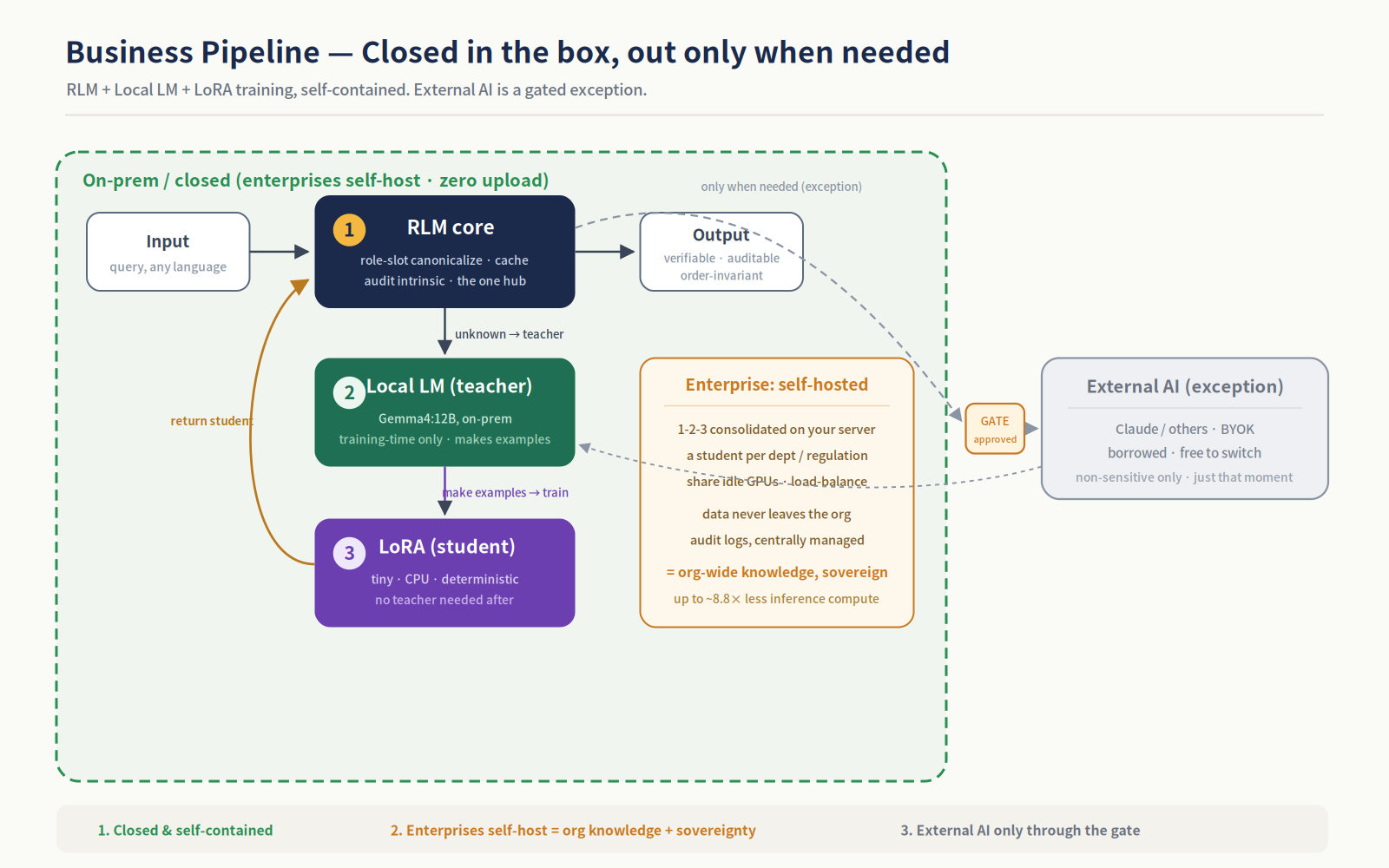
The other half
If the clamp says “don’t take it on trust”, the vault says “don’t let it out”
The clamp constrains the output. But if the original never leaves the boundary in the first place, then even a model you do not trust cannot carry anything out. Input purification and output clamping ― only with both ends in place does a model’s origin stop mattering for confidentiality.
The original never crosses the boundary ― Local LLM Vault →Tenets
- Borrow intelligence; never surrender the clamp.
- Sovereignty is the final authority to validate output, not ownership of it.
- Routine, precompiled; atypical, authored on the spot. Standard logic is deterministic and precompiled; atypical (sudden, person-dependent) logic is written as lisp-jit rules on the spot — turning tacit judgment into versioned, deterministic, reversible rules.
- Flexibility is the freedom to write rules; determinism is evaluation under a pinned version. The bridge is hashing the rule version and its author.
- Fold, clamp, record. With both ends exact (canonicalization in, clamp out), the whole closes bit-exact even with a free AI in the middle.
- Close in the box; only the residual is gated out. Neither data nor generation leaves. External AI is a gated exception.
- Method open; the clamp core in the sovereign's hands.
Who this is for ― democratizing AI sovereignty
Sovereignty stops being the privilege of those who can own a giant model. The clamp is light (tiny, CPU, WASM, deploy-free), so holding it takes no vast capital.
Your agent is yours; your criteria stay in your hands.
No chasing the latest giant model. Borrow the teacher; own the clamp. No vendor lock-in.
You need not build the frontier to keep sovereignty — hold the clamp. A path other than subjugation to big cloud.
Honest limits ― so the flag can bear weight
- The clamp only clamps what you wrote. It does not guarantee the rule itself is correct. → You hold the sovereignty of validation and reversibility, not of correctness (person-bias is reviewable/rollback-able via version-pin + author).
- Borrowed intelligence = borrowed capability ceiling. Sovereignty is over use and validation; the capability frontier still depends on the teacher. Sovereign, not omnipotent. Yet holding "what counts as valid" is the core of autonomy and dignity — and that is enough.
- Bit-exact means identity of integer meaning. It presumes the discipline of keeping floating-point and platform-dependent code out of the clamp layer.